Paolo Lettieri: Bridging Cultures Through Architecture
Reporting an article about me published on Big News Network on May 6, 2025:
Paolo Lettieri is an Italian architect recognized for his refined approach to design that transcends geographical and cultural boundaries. His work is not merely about constructing buildings but about fostering understanding between different societies, histories, and traditions.
A Global Vision Rooted in Italian Heritage
Born and educated in Italy, Paolo Lettieri’s architectural style is deeply influenced by the rich artistic and architectural history of his homeland. Italy, with its blend of ancient ruins, Renaissance masterpieces, and modern innovation, provides the perfect backdrop for an architect who values both tradition and transformation.
Lettieri’s early works often reflected classical Italian design principles-balance, proportion, and harmony. However, as his career progressed, he expanded his practice to include projects in different countries and cultural environments, prompting him to reimagine these values through a broader, more inclusive lens.
Designing for Dialogue
One of the defining features of Paolo Lettieri’s architecture is his ability to design spaces that act as cultural crossroads. In cities such as Amman, Abu Dhabi, and Baghdad, where East meets West, Lettieri has worked on architectural projects and masterplans that embody the multicultural identity of these places.
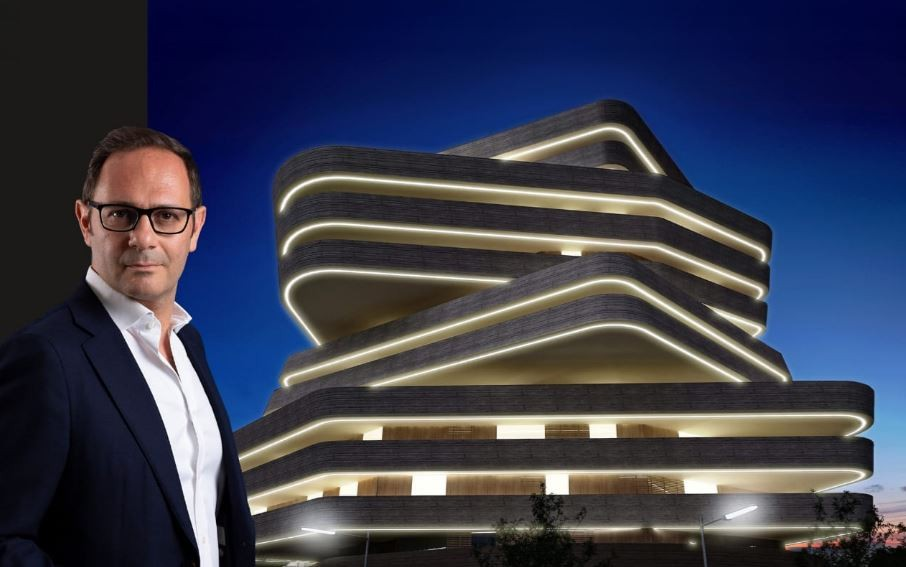
In Amman, for example, he designed a residential and mixed-use building near the Third Circle, characterised by the use of exposed reinforced concrete, plaster, and local stone for the base. The building’s stratified tectonic form and mass engage in a dialogue with the city’s traditional constructions, imagining a layering that begins with a stone base and continues with overlapping elements. This approach creates a complex that is both impactful and deeply rooted in the city’s fabric.
Sustainable and Contextual Architecture
Lettieri is also known for his commitment to sustainability-not just in terms of materials, but in his respect for the social and cultural ecosystems of the areas he works in. He emphasises adaptive reuse of old structures, local labour, and low-impact construction methods.
By combining local craftsmanship with modern engineering, his work contributes to the preservation of traditional skills while meeting contemporary needs. This approach results in buildings that are not only environmentally sustainable but also socially responsible.
Influences and Philosophy
Inspired by architects such as Eero Saarinen, Alvar Aalto, Carlo Mollino, and Hassan Fathy, Lettieri believes that architecture should tell a story. His designs often feature elements such as natural light, flowing spaces, and tactile materials that invite people to engage with the space in a sensory way.
Lettieri once noted in an interview:
“Every building is a conversation-with its surroundings, its users, and its past. My job is to make that conversation meaningful.”
Cultural Projects and Education
Beyond his architectural practice, Paolo Lettieri is also involved in educational and cultural initiatives. He has contributed to specialist magazines and delivered lectures on intercultural design, encouraging young architects to see architecture as a tool for peace and inclusion.
In collaborative projects, Lettieri explores how built environments can shape people’s lives and how architects can serve as mediators in diverse societies.
A recently published architectural monograph on his work, Paolo Lettieri – Architectures in the Middle East, Europe and Asia (Altralinea Editions, Florence, 2024), includes a long interview with him and an introduction by international architecture critic Luigi Prestinenza Puglisi.
Conclusion: Building Bridges, Not Just Buildings
In a time when cultural misunderstandings often lead to division, Paolo Lettieri’s work is a refreshing reminder of architecture’s potential to unite. Through each of his projects, he continues to craft spaces that celebrate diversity, honour tradition, and inspire connection.
His architecture is not ostentatious; it is reflective. It speaks softly, yet carries a strong message: we are different, and that is beautiful.