Making Virtue of Necessity: the VGIK Auditorium Project
Among all the projects I have been lucky enough to build, there is one that feels particularly mine. Not the largest. Not the most visible. But the one in which every choice has a reason I can tell — not invented after the fact, but a reason that was already there, guiding my hand while I was drawing.
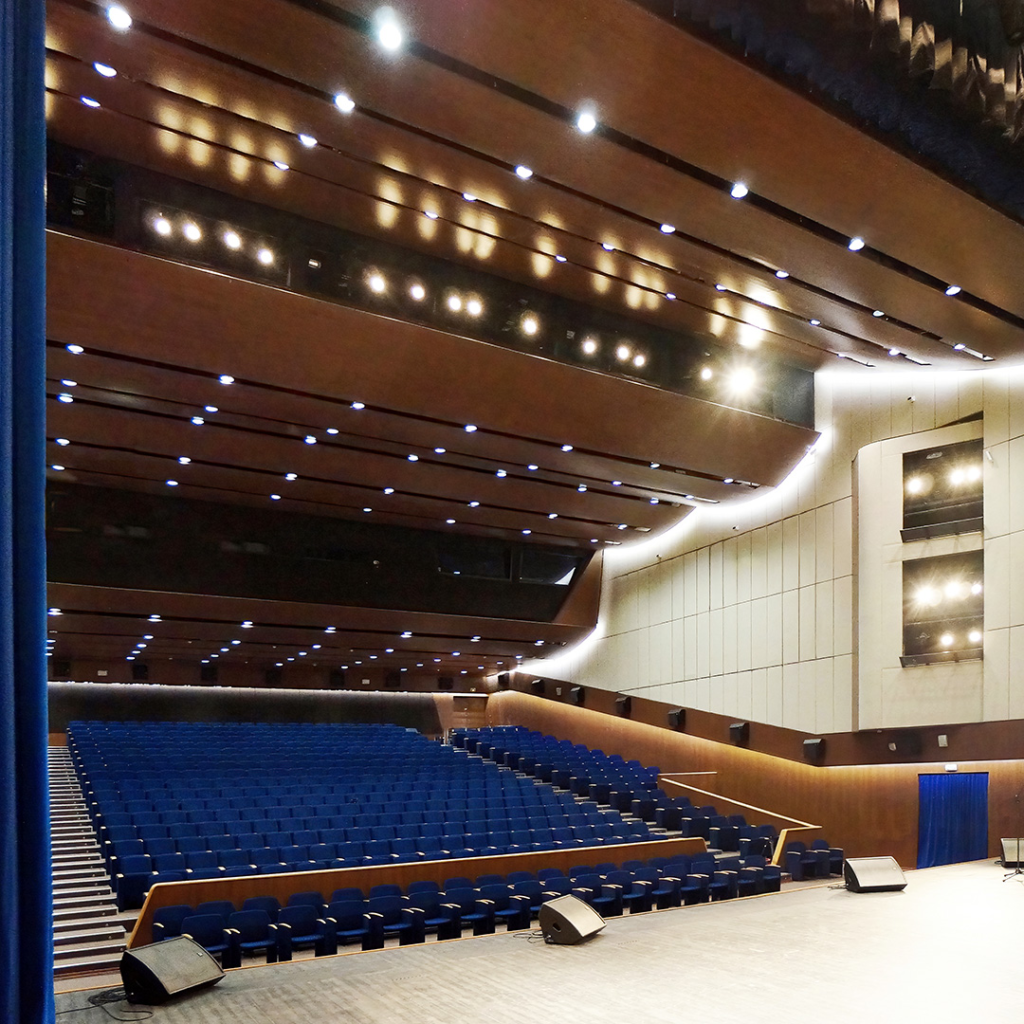
That project is the Auditorium of VGIK — the Gerasimov Institute of Cinematography in Moscow. The oldest film school in the world, founded in 1919.
I have never been especially fond of design manifestos.
Those texts where architects explain their “vision” in language that sometimes seems more designed to impress than to communicate. But if I have to sum up how I work in a single phrase, I use a proverb I like: make a virtue of necessity.
My architecture always comes from an encounter — often from a tension — between two forces. On one side, the reasons of the building: functionality, physical performance, technical constraints. On the other, intentions: mine as designer, the client’s, and not least the cultural context and the place. Form does not follow function alone, as Sullivan believed. It also follows memory, desire, available materials, available resources. When all these tensions find a single solution, the project stops being an engineering exercise and becomes architecture.
The VGIK is, for me, the clearest example of all this.
The Problem: Three Objectives That Were Hard to Reconcile.
When I received the commission for the auditorium of the VGIK’s new building, the client had set three simultaneous objectives. Which were, at least on the surface, in contradiction with one another.
First: the hall had to work both as a cinema — the university’s historic vocation — and as a theatre and concert hall. The answer could be variable acoustics: a room capable of transforming itself according to its use.
Second: it had to have the best acoustics in Moscow. Not good: the best. A few years earlier, a new concert hall had opened in Moscow with terrible acoustics, and it had been a scandal. To avoid any risk, an excellent Italian acoustic engineer had been brought in — Marcello Brugola — who in turn involved me in the project.
Third: the main finishing material had to be Topakustik, a high-performance perforated wood panel produced by Fantoni.
Three constraints, three different directions. Not a project born in a comfort zone — but one that could push me to do something genuinely good, and to show what method and passion can achieve.
The Curved Ceiling: Physics First, Form Second.
The first question I asked myself — and put to Marcello — was acoustic, not aesthetic: how do you make a hall that “sounds good” everywhere?
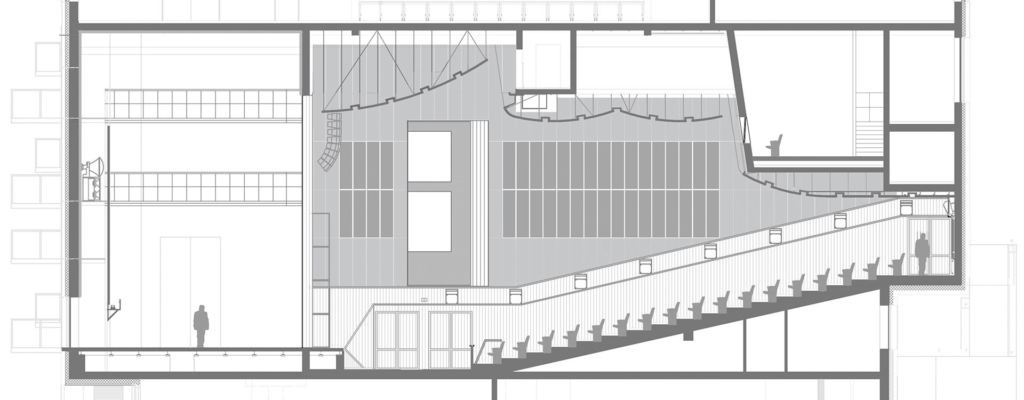
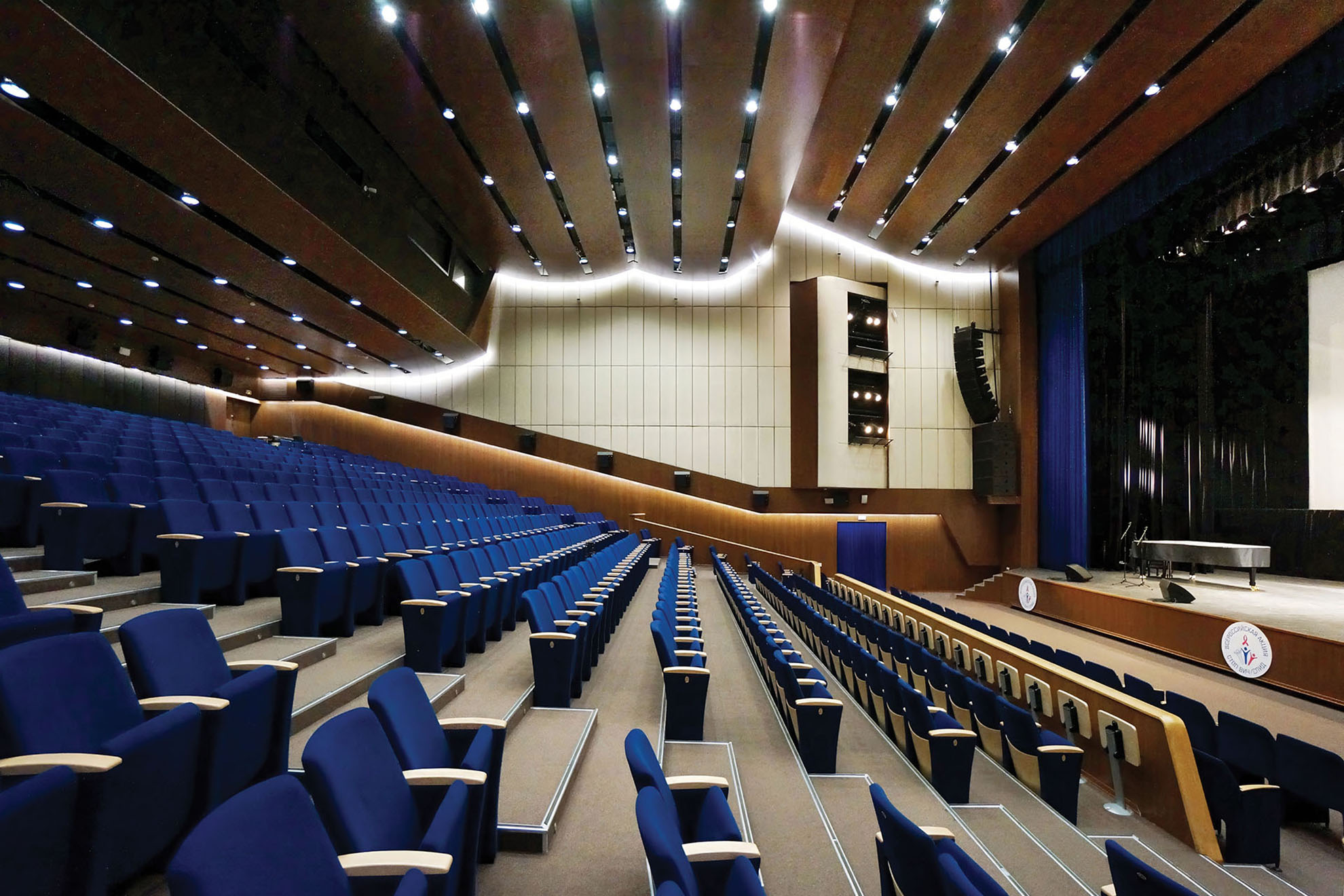
An auditorium works when every listener — in the front row as much as the last — perceives sound uniformly. The enemy is concentrated reflection: sound waves that bounce off flat or concave surfaces and converge at specific points in the hall, creating zones where sound arrives doubled and zones where it barely arrives at all. Convex curved surfaces solve the problem: they scatter reflections, distributing them through space. A convex curved ceiling is, physically, the optimal form for controlling sound propagation in a large hall.
So much for the physics. The problem was translating it into something buildable.
The Material and the Right Measure — or: When You Go Beyond the Stated Limit.
The client had chosen Topakustik. It is an excellent material — you can find it at the Times Center in the New York Times Building, at the Burj Khalifa — but it was designed to be installed flat. Curving it is possible, but only up to a point.
I had long discussions with the Fantoni technicians. The safe limit, they told me, was around a 4-metre radius. Beyond that, the risk of tension and deformation in the material increased significantly.
I analysed the situation, and the result was designing the ceiling section with a fixed radius of 5 metres.
Calculated to achieve an optimal geometry that would work across the different parts of the hall, while staying within the material’s real safety zone for deformation. The resulting geometry satisfied three things at once: optimal acoustic dispersion, constructability with the chosen material, and — and this is where the technical problem makes the leap and becomes architecture — a cross-section that gave the hall an appearance unlike anything conventional.
The Unconscious Memory: Aalto and Utzon.
While I was drawing the profile of that section, trying different curves, I had the feeling I was drawing something familiar. As if I had already encountered that form. As if I had been looking for it without knowing it.
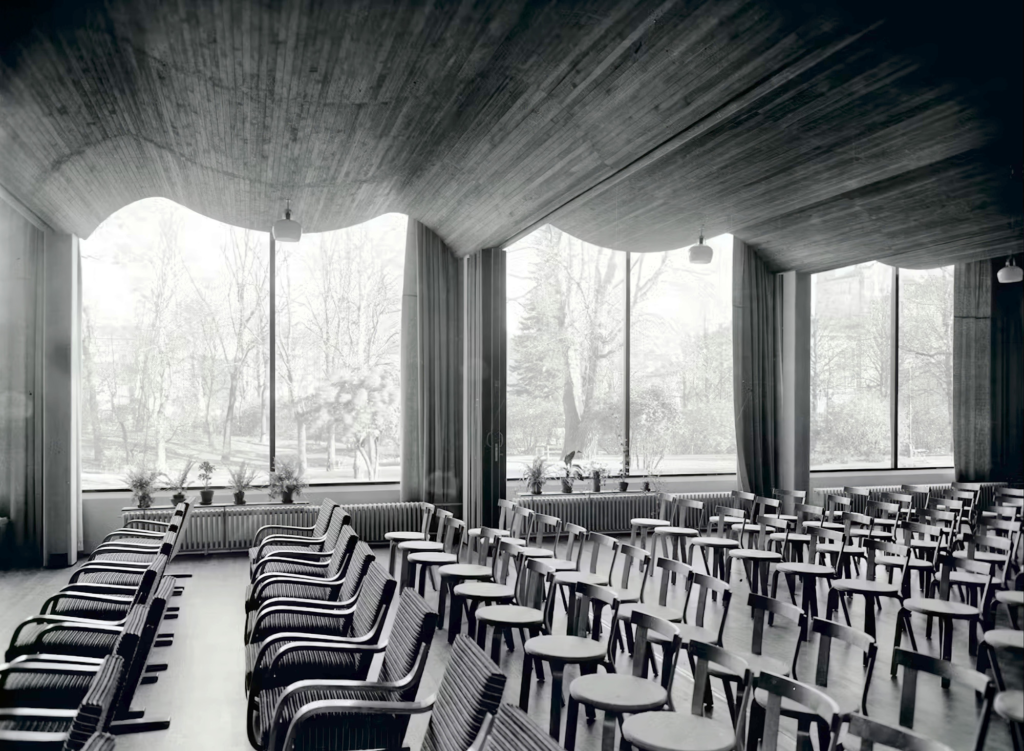
I understood later: during my university years, studying twentieth-century architecture, two ceiling sections had struck me deeply. The section of Alvar Aalto’s Viipuri Library (1935) and that of Jørn Utzon’s Bagsværd Church (1976). Two projects studied and present in my history of contemporary architecture textbook — Frampton. Both with ceilings born from precise functional requirements — the control of natural light in the first case, acoustics and a certain idea of spirituality in the second — that had become iconic forms.
I have never seen these buildings in person. And yet their sections had stayed with me like a visual grammar, buried somewhere. When the technical necessity of the VGIK pushed me toward that form, something recognised it as right. It was not a quotation. It was an unconscious confirmation.
The Rotating Panels: A Second Logic, A Second Form.
Marcello Brugola had a clear idea: a system that would allow the acoustics of the hall to be varied in real time, moving from the optimal configuration for cinema to that for theatre or concert.
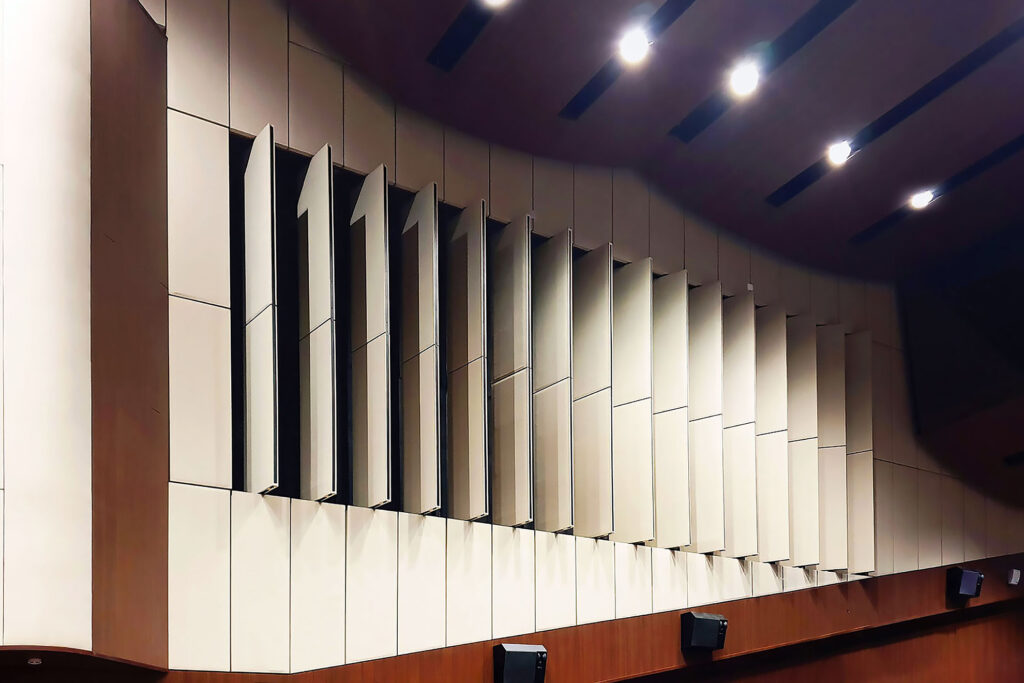
The technical solution was rotating panels on the lateral walls — lined on the sound-absorbing side with fire-resistant Trevira fabric and on the other with reflective wood panels — controlled by sensors and dedicated software. In practice: the software calculates the optimal reverberation time, the motors behind the panels turn, and the acoustics of the hall change with millimetric precision.
The shape of the panels is rectangular. Not as an aesthetic choice. For a precise functional reason: to build the rotation mechanism in a simple and reliable way. And the spacing between one panel and the next — 60 centimetres — is not a number chosen at random: it is the width that allowed the Trevira fabric to be fitted without any material waste.
Again: necessity becomes measure, measure becomes rhythm, rhythm becomes design.
The Result: Curved Against Orthogonal.
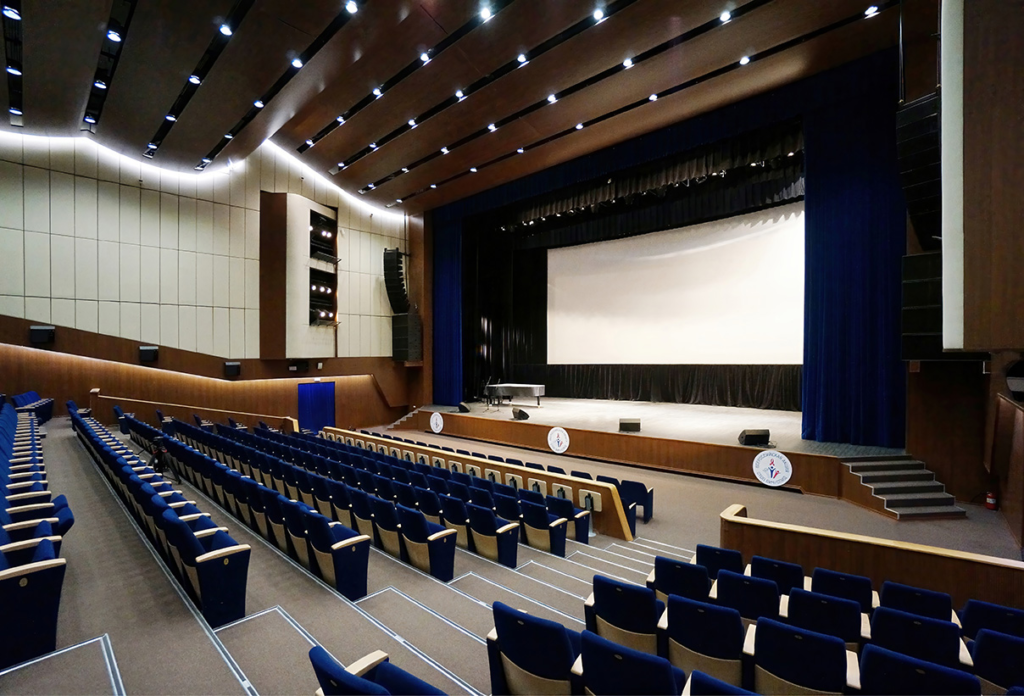
The great curved ceiling and the rectangular panels on the walls create a compositional dialectic that defines the character of the hall. The organic, fluid ceiling shapes the space from above. The walls, marked by a rigorous module, give a repeated orthogonal order. Curved against rectangular. Organic against technical. Continuous against modular.
This is not a compromise between two opposing needs. It is a productive tension — the same that exists between music and the space that contains it. And like a good composition, every element finds its meaning in relation to the other.
The Inauguration, the Awards — and What Really Remained.
The auditorium was inaugurated by Russian President and quickly became one of Moscow’s key cultural venues — for its acoustic quality, its flexibility of use, and a design that resembles no other auditorium.
I received international awards for this project: the Bronze Award at the IDA Design Awards 2020 and an Honorable Mention at the Architecture MasterPrize in Los Angeles. Gratifying, of course.
But what has really stayed with me is something else. It is the awareness that every formal choice in that project has a reason I can tell. Not a reason built at a desk to justify the aesthetics, but a reason that was already there while I was drawing.
This, for me, is making architecture.
Final Note
My philosophy, if I really must put it into words, is this: the best form is the one that simultaneously satisfies the greatest number of needs — functional, technical, cultural, aesthetic — with the fewest possible elements. This is not simplicity for its own sake. It is synthesis.
The VGIK confirmed something for me: the best projects do not come from absolute freedom. They come from the encounter — often from the clash — between necessity and will. And the form that feels “right” before you fully understand it is often the one that your cultural memory has already approved, across the years in which you studied, looked, and forgot that you remembered.
Final Note 2
Unfortunately, this auditorium is in Moscow — designed between 2011 and 2016, in unsuspecting times — and located in a country that currently interests very few people, for obvious reasons. Not exactly easy to visit, and not exactly easy to publish.